I mentioned a while back that I would love to read a good objective history about unions. Sadly, if any of you three readers know of one, you have not passed on that information. ;-) It is certainly in the forefront of many Americans' lives right now. I do not pretend to know what is best or that I understand fully the issues or budget in WI. I know people who are required to pay union dues in both the public and private sectors; who while maybe their salary and benefits are better compensation for their education, training, and effort than they might be without a union, have found themselves in ridiculous, illogical situations or not getting a job because of union rules and/or internal politics.
I wonder whether ultimately, people should just have the option to pay those dues or not. That way, the workers decide if they unions are worth it and are not forced in or out of unions due to legislative action or established unions. I guess that would get tricky, but still. I mean, if it is a budget issue and unions make requested financial concessions, what's the big deal? How can legislators argue they are representing Americans when so many Americans clearly do not agree with them?
My biggest issue/concern/problem with unions is how notoriously they protect the lazy and undeserving worker (see above reference to a friend who did not get a union job due to internal union politics/excuses). I think that the good workers get punished for that. While I and others could then argue that the good valuable workers would have nothing to worry about without a union if they are good valuable workers, at the heart of the matter is maybe whether that is a valid argument. I could envision without a union that a productive, hard-working public employee of many years would be laid off because over those years their salary and benefits had increased such that the public entity would rather replace them with an entry-level cheaper employee. That certainly has been known to happen in the private sector, but is it right that it happens in the public sector? And would it only happen in some areas, say education or nursing, and not in others, say police and fire? Then it would not be fair.
Regardless, I would be interested to hear firsthand or otherwise, anonymous or not, experiences or opinions with/about unions, their role and importance historically and in modern times in promoting worders lives.
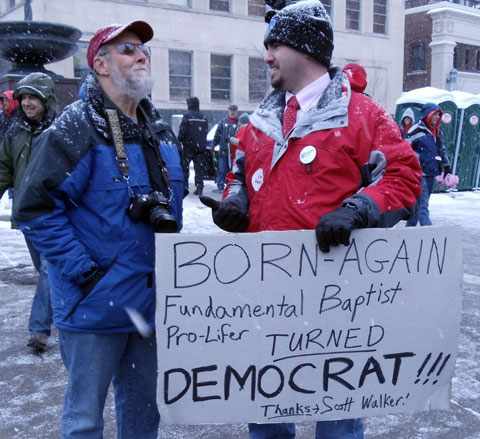
This whole long rambling post was purely because I got an email with photos from the demonstrations of solidarity across the country and LAUGHED at this one in particular.

4 comments:
That's an awesome picture! I, too, have mixed feelings on unions--mostly because they DO protect the lazy worker,and I think they often using bullying tactics, and how constitutional are they if you HAVE to participate to have your job?! That being said, I'm torn, because of situations like Providence, RI who just sent every public school teacher a termination notice, giving them the opportunity to completely fire any/all teachers at the end of the year. This, apparently, is a loophole in the union's contract that not only gives the city more freedom in who to rehire (not bound by seniority or paycheck, so can hire back only cheaper teachers if need be--this was a 'budgetary' move because of an enormous deficit--and not necessarily more senior teachers who might be fabulous at their jobs), but it relieves them of fiscal responsibilities that would have happened had they just laid off the teachers AND it now puts a "termination" on the teachers' resumes who are not rehired, which is just a sucky situation overall, but which I also blame the unions for pushing the town into doing by not giving them more flexible options to work with a huge budget deficit. So again, double-edged sword. The union that protects their jobs also screwed their jobs. Hhhmmm...
I think the part of public unions that disturbs me the most is that most often, the brunt of the budget issues are put on the shoulders of education and other public offices you hear little about. I get that police and fire are important to public safety, yet they stand by the other unions who are just as crucial to the societal standards many/most/all of us have come to expect.
And here is a funny from the FB: "A public union employee, a tea party activist, and a CEO are sitting at a table with a plate of a dozen cookies in the middle of it. The CEO takes 11 of the cookies, turns to the tea partier and says, 'Watch out for that union guy. He wants a piece of your cookie.'"
Early in my grad student time at Brown, there was a push to unionize the grad students. Although in some settings I think unions can do good things, I was opposed to two major parts of this push: 1) only those grad students who were TAs could vote, but if it had been approved future TAs who didn't have a vote would be forced to join/pay; 2) they were going to join with the UAW, and I couldn't really see how auto workers and grad students had much in common. Anyhow, the votes were impounded and never counted, so nothing ever came of it.
My only literary experience with unions is The Jungle, but that's not really what you're looking for, I imagine.
Carolyn, I talked with a grad student whose student body was in the process of unionizing and he had been heavily involved with pushing it through. He said that in retrospect, it would have been a better idea to increase communication with the administration to push grad student concerns than go the unionizing route. So it's probably a good thing those votes were impounded. Why were they impounded?
Post a Comment